-
“I signed a one-year contract through campus recruitment, hoping to give it a try, but it turns out I have been working for nearly 17 years.” Reflecting on his post-graduation from the master’s degree at Tianjin University of Traditional Chinese Medicine, Zhang Yanbin had numerous job opportunities to choose from. Some northern enterprises even offered him a ten-year contract that provides housing. Nevertheless, as a northerner, he resolutely travelled south to Shenzhen and joined CR Sanjiu.
It was not only the better air quality in the south that drew Zhang Yanbin, but he was also captivated by the “Open and Inclusive, Work Focused” atmosphere of CR Sanjiu. “Whether it is work or life, the environment here makes you feel comfortable, the ambience is great for doing research without many distractions. Management focuses more on the results. We are free to leverage our abilities in the process. We have plenty of research funds and our company has always encouraged us to be innovative, that is why we can dedicate ourselves to research with enthusiasm every day.”
In the field of pharmaceutical R&D, the speed of talent growth and innovation capabilities are directly linked to the core competitiveness of enterprises. By establishing a “practice-driven, diverse empowered, and culturally immersive” talent cultivation system, CR Sanjiu paves the way for researchers to grow from inexperienced newcomers to industry experts.
According to Shi Yonggang, Deputy Director of the Mass Work Department of CR, CR has strived to promote new corporate apprenticeship and modern apprenticeship programs that systematically advance the “Pathfinder Plan”, being dedicated to skill inheritance and technical backbone cultivation. Under the leadership of CR, various units also prompted the development of a skilled talent pool through different methods.
Long-term Empowerment Mechanism: From Campus to R&D Frontline
Zhang Yanbin, currently the Chief Engineer of the R&D center, has made great progress thanks to his dedicated research efforts on his journey. His desk has always been filled with books, from medicine to interdisciplinary fields. DeepSeek, which has gained popularity recently, is also among the books he bought to study. In the view of Zhang Yanbin, “you will be abandoned by the times if you do not keep learning, and you must keep learning to do scientific research because the knowledge required is incredibly broad.”
Self-cultivation depends on individual effort, but it also requires a mentor to show the way. Zhang Yanbin’s growth at CR Sanjiu would not have been possible without the “passing on, helping and guiding” training model. “When I first joined, I followed my mentors into the workshops. The laboratories at college focused more on basic research. Once you entered a company, you take part in actual production. Whenever opportunities arise, I seized them to go to the workshops,” Zhang Yanbin said.
From Liu Zhigang, mentor of Zhang Yanbin in his early career, to Wang Yong, general manager of the R&D center, these seasoned experts continued to act as “pathfinders” for Zhang Yanbin and other researchers. “In scientific research, everyone is equal. You are welcome to ask questions or seek advice directly at any time. If you encounter any problem, you can discuss it with them anytime. Even if it means calling them at 11 p.m., they will patiently answer your questions.” This cross-level technical exchange mechanism allows knowledge and experience to be quickly transferred within the organization.
This learning-by-doing approach also allowed Zhang Yanbin to establish a connection between scientific research and thinking and engineering practice early in his career. From 2008 to 2010, he participated in the R&D of multiple projects and progressed from ordinary team member to project manager, achieving his first professional transformation.
The trust that CR Sanjiu places on newcomers is reflected in its training strategy of “shouldering responsibility”. In 2011, Zhang Yanbin, taken up office for just two years, was entrusted with a major task to lead the project of developing “SQGG Granules”, a new Class 1 drug for stroke treatment. “It is incredible that the company would put a newcomer in charge of a new drug project,” he remarked. This daring appointment was supported by the “Mentor Support” mechanism established by CR Sanjiu, under which seasoned experts provide technical support to newcomers to ensure the projects are progressed with manageable risks.
Although that project ultimately failed to launch onto the market due to clinical risks, this experience enabled him to systematically master the entire new drug research and development process, and started to give him a sense of satisfaction and accomplishment in his career. “Just over a year into the project, we obtained the supplemental clinical approval - the first I ever received,” Zhang Yanbin recalled.
At CR Sanjiu, talent cultivation is no single dimensional training, but a multi-dimensional system that includes practical opportunities, resources support and career development. According to Zhang Yanbin, “before 2015, the R&D center only had several tens of millions of investments each year; however, by 2024, it almost reached one billion.” With sufficient funding, frontline R&D workers are empowered to pursue innovative exploration.
The “dual channel” promotion mechanism that is introduced after the organizational restructuring in 2012 has opened doors for technical talents to move up the career ladder. “You can only take the management path in the past, but now you can opt for professional paths such as managing director or first-class/second-class engineer.” This system is designed to allow researchers to focus on their expertise and avoid “bureaucrat-centered” tendencies that would put restrictions to technological developments.
In the beginning, Zhang Yanbin studied traditional Chinese medicine in college and began to oversee chemical drug projects after the organizational restructuring in 2012. Facing a huge gap in professional knowledge, systematic training provided by the company has become a crucial support. CR arranged professional training in project management and drug analysis for researchers including Zhang Yanbin, and encouraged technical personnel to participate in external seminars. This continuous learning approach empowers researchers to expand their capabilities. Today, Zhang Yanbin is a master of drug development and has gained extensive experience in the field of chemical drugs, thus becoming a versatile talent in R&D.
Since 2017, Zhang Yanbin has been successively leading multiple projects to approval. Among them, the ambroxol hydrochloride oral solution for cough treatment has become a blockbuster product that achieved several tens of millions of sales annually.
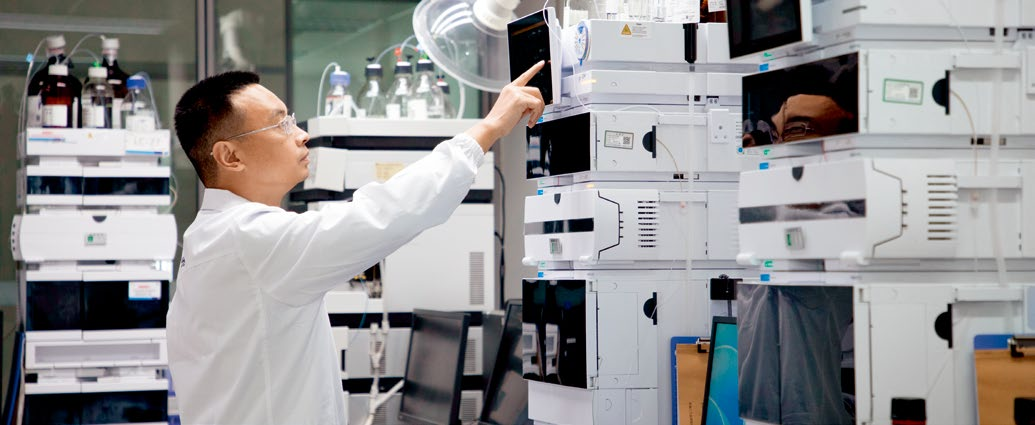
>Zhang Yanbin participated in the development and research of the Yiqi Qingfei project During the post-pandemic period, Zhang Yanbin faced immense pressure when developing a new coronavirus recovery and treatment drug “Yiqi Qingfei Granules” as he had no prior experience in the research and development of similar drugs that the project was essentially built from scratch. Under the grueling challenge of a six-month application deadline for marketing, he led his team in an unconventional approach, running parallel research in 11 laboratories. During the industrialized production phrase, Zhang Yanbin and his team worked around the clock, entering the workshops at 7 a.m. and leaving at 2 a.m. for many days, observing and analyzing every detail in the workshops. “To ensure successful industrialization, we had to observe, record and analyze meticulously to achieve stable mass production quality.” After day and night efforts, the project has been successfully approved in January 2025, filling the domestic gap in new drug development for pandemic recovery and treatment.
Supporting Talents: From Personal Growth to Organizational Capability Enhancement
As a senior expert who started from entry level, Zhang Yanbin has now taken up the mantle of mentoring new talents. Under his mentorship, he tailors his teachings to individual strengths, helping youngsters to find suitable paths. When assisting with their planning, he sets objectives and shares his experience to help them achieve their goals. He used to tell the youngsters, “there is no hierarchy or seniority. Discussions are about who makes the most sense, not who has the higher rank.”
For his expectations on talents, Zhang Yanbin stated, “first, you observe their passion in research, then cultivate their innovative thinking, disciplined attitude and a habit of continuous learning.” This approach has proven effective, with some of his mentees being able to lead projects independently within six months and take on project manager roles in around a year.
In the opinion of Zhang Yanbin, CR Sanjiu is a fertile ground where young talents can flourish. Its R&D mechanisms avoid the issue of “coaching the apprentice would starve the master”. “Since everyone will take part in projects, the internal passing on, helping and guiding system encourages the mentors to expect their apprentices to progress faster. Moreover, CR Sanjiu not only encourages and arranges researchers to participate in various work-related training but also encourages them to frequently attend industrial training sessions, presentations and exchanges with college teachers so as to learn from the industry and to learn from practice.
In building of a long-term talent cultivation system, CR explored innovative models like the “Professional Engineer Program”. Collaborative cultivation programs with universities allowed students to gain practical exposure in companies and demonstrated seamless integration of school education and industry demands. This “industry, academia, and research” cultivation model has equipped CR with quality candidates of talent.
Currently, the talent cultivation model of “industry, academia, and research” of CR Sanjiu is creating a “virtuous cycle” effect. As outstanding talents gradually emerge, the R&D capabilities of the company continue to strengthen, delivering streams of innovative results constantly. From the early R&D of traditional Chinese medicine to the current multi-field layout of chemical drugs and biological drugs, the R&D capabilities of CR Sanjiu rank among the top tier in the industry. The R&D investment of CR Sanjiu ranks among the top five as a traditional Chinese medicine enterprise, significantly surpassing the industry average.
Recently, Zhang Yanbin was awarded the “National Model Worker”, which is an epitome of the CR Labor Union’s efforts in creating platforms to assist employees achieve success. Shi Yonggang stated that CR has created “exemplary and leading” platforms, selected “CR outstanding craftsmen”, and promoted the establishment of new innovative workstations for model workers and talented craftsmen.
From the “mentoring system” in early employment to the “dual channel” for career development, coupled with sufficient R&D investments and flexible management mechanisms, and supported by a strong “passing on, helping and guiding” culture, each aspect provides nourishment for talent growth.
In today’s increasingly competitive pharmaceutical industry, CR is building a formidable R&D team capable of tackling tough challenges and achieving victories by continuously optimizing its talent cultivation system. As noted by Zhang Yanbin who rises from an inexperienced newcomer to an expert in R&D, “in here, as long as you have ideas and are willing to learn further, the company is a stage for you to succeed. Such respect and cultivation of talents is the central strength of CR’s competitiveness”.
-
Our Philosophy